
Recorder Notes Chart
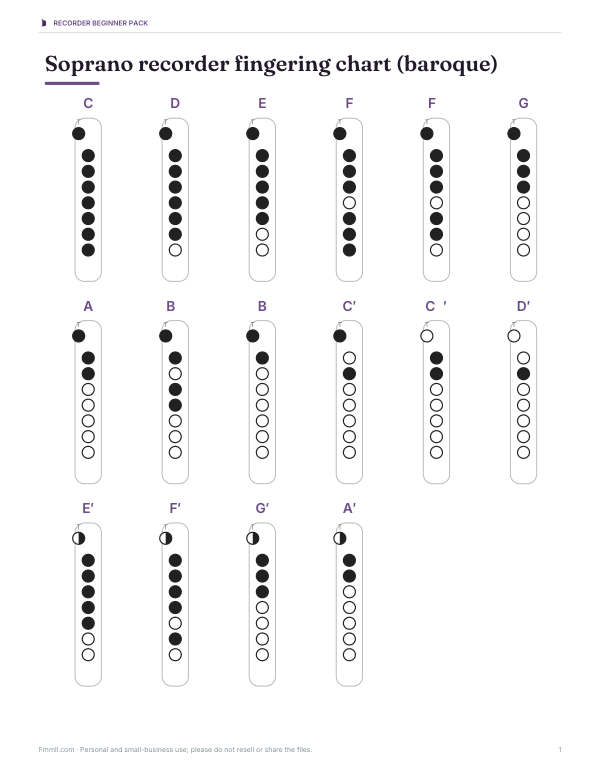
Tap a note to see which holes to cover on a soprano (descant) recorder and hear what it should sound like. The chart shows baroque fingering from low C to high A, including the common sharps and flats, and the song tool turns a line of note letters into a row of fingering diagrams you can practise from.
- Free to use
- No sign-up
- Runs in your browser
Interactive recorder fingering chart
Song fingering sequence
Recorder Beginner Pack
Printable soprano recorder fingering chart (baroque), a beginner song book with fingering diagrams, a practice log and a note-naming worksheet with answers.
- Fingering chart (PDF)
- Beginner songs (PDF)
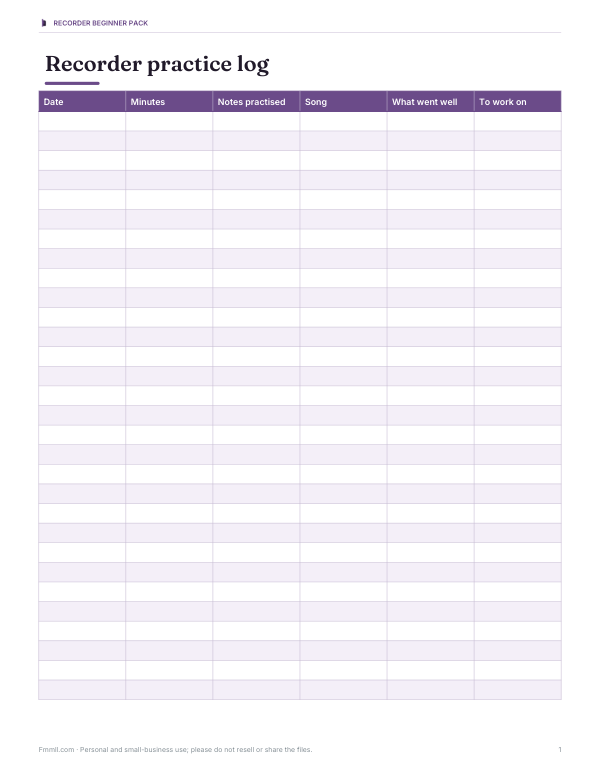
- Practice log (XLSX)
- Note naming (PDF, DOCX)
Formats: PDF, DOCX, XLSX. Instant download after payment (link valid 72 hours, up to 5 downloads). AI-assisted: the templates were drafted with AI help and reviewed and laid out before publishing.
$5.00 USD, one-time 4 files · about $1.25 each
- Instant download
- 7-day refund
- Secure checkout by Stripe
7-day money-back guarantee. Full refund within 7 days of purchase, even after you download.
Free sample: Beginner Songs With Fingerings (PDF, 59 KB)
Full refund within 7 days — see the refund policy and license.
Free printables
Single sheets you can print right now, no sign-up. The full pack adds every sheet in one download plus the editable files.
 Printable Recorder Note Naming Sheet
How to read a recorder fingering chart
Each diagram shows the recorder from the front, with the thumb hole on the back drawn to the side at the top. A filled circle means cover the hole; an open circle means leave it open; a half-filled circle on the thumb means “pinch” — leave a small gap at the top of the thumb hole, used for high notes. Holes 1–3 are covered by the left hand (index, middle, ring) and holes 4–7 by the right hand (index to little finger). Holes 6 and 7 are double holes on most recorders, used for low sharps and flats.
Soprano recorder notes (baroque fingering)
| Note | Thumb | Holes 1–7 |
|---|---|---|
| C | closed | 1 2 3 4 5 6 7 |
| D | closed | 1 2 3 4 5 6 – |
| E | closed | 1 2 3 4 5 – – |
| F | closed | 1 2 3 – 5 6 7 |
| F♯ | closed | 1 2 3 – 5 6 – |
| G | closed | 1 2 3 – – – – |
| A | closed | 1 2 – – – – – |
| B♭ | closed | 1 – 3 4 – – – |
| B | closed | 1 – – – – – – |
| C′ | closed | – 2 – – – – – |
| C♯′ | open | 1 2 – – – – – |
| D′ | open | – 2 – – – – – |
| E′ | pinched | 1 2 3 4 5 – – |
| F′ | pinched | 1 2 3 4 – 6 – |
| G′ | pinched | 1 2 3 – – – – |
| A′ | pinched | 1 2 – – – – – |
Recorders are marked as baroque (English) or German fingering. The difference shows mainly in F and F♯; this chart uses baroque fingering, the most common on school and quality recorders. Check the recorder’s packaging or maker if unsure.
First notes to learn
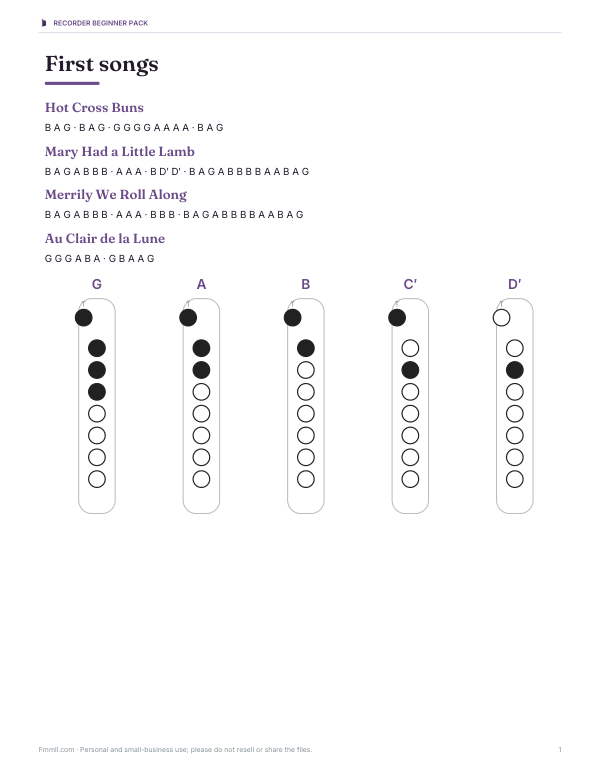
- Start with B, A and G using only the left hand — many first songs, such as “Hot Cross Buns” and “Mary Had a Little Lamb”, use just these three.
- Add high C′ and D′ for simple tunes with a wider range.
- Learn E and D with the right hand, keeping holes sealed.
- Low C needs every hole perfectly sealed and very gentle breath.
- Learn F and F♯, then the pinched high notes.
Getting a good sound
- Blow gently, like warm breath on your hand — too much air makes a squeak.
- Start each note with a soft “doo” or “too” with the tongue.
- Cover holes with the pads of your fingers, not the tips.
- Low notes need the gentlest air; high notes a little more.
- If a note squeaks, check each hole for small gaps.
- Keep your right thumb under the recorder between holes 4 and 5 for support.
Soprano vs alto recorder
The soprano (descant) recorder is the common school instrument, with the lowest note C. The alto (treble) recorder uses the same finger patterns but its lowest note is F, so each fingering produces a note a fifth lower — the pattern called C on a soprano plays F on an alto. Tenor recorders read like sopranos an octave lower. Soprano and alto recorders sound an octave higher than written, which is why the pitch played here for written C5 is 523 Hz.
Worked example: “Hot Cross Buns”
Type B A G, B A G, G G G G, A A A A, B A G into the song tool and it shows each fingering in order. The tune only uses three left-hand notes, so it is a perfect first piece. Press “Play sequence” to hear the melody at a steady pace, then play along slowly, checking that your fingers seal the holes fully on G.
Reading music for recorder
Recorder music is written on the treble clef. The notes on the lines, from bottom to top, are E, G, B, D, F (“Every Good Boy Does Fine”), and the spaces spell F, A, C, E. Middle C sits on a short ledger line below the staff — on the soprano recorder that is the lowest note. High D sits just above the top line. Learning to read the handful of notes in your first songs is enough to start; add new notes as they appear in your music.
Practice tips for beginners
- Practise little and often — ten minutes a day builds finger memory quickly.
- Use a mirror to check that fingers stay close to the holes.
- Play slowly and evenly before trying the song at full speed.
- Record yourself on a phone to hear squeaks and uneven notes.
- Learn one new note at a time and use it in a simple tune.
- Keep the recorder at about a 45-degree angle, lips lightly around the mouthpiece.
Caring for a recorder
Warm the recorder in your hands before playing to reduce condensation. After playing, shake out moisture and dry plastic recorders with a cleaning rod and cloth; wash plastic recorders occasionally in lukewarm soapy water and rinse well. Wooden recorders need gentle care and occasional oiling as the maker recommends. Store recorders in their case, away from heat.
Privacy
The chart and sounds are generated in your browser.
Frequently asked questions
What is the fingering for G on the recorder?
Thumb and holes 1, 2 and 3 covered.
Why does my recorder squeak?
Usually blowing too hard or a hole not fully covered.
What is the difference between baroque and German fingering?
Mainly F and F♯ fingerings; baroque is more common and in tune across the range.
What does a half-covered thumb mean?
Pinch the thumb hole, leaving a small gap, to play high notes.
What notes should beginners learn first?
B, A and G with the left hand.
Can I hear the notes?
Yes, tap any note to hear its pitch.
How do I play low C without squeaking?
Cover every hole completely, including the double holes, and blow very gently.